
Travel Tips
Lorem ipsum dolor sit amet, consectetur adipiscing elit.

Search
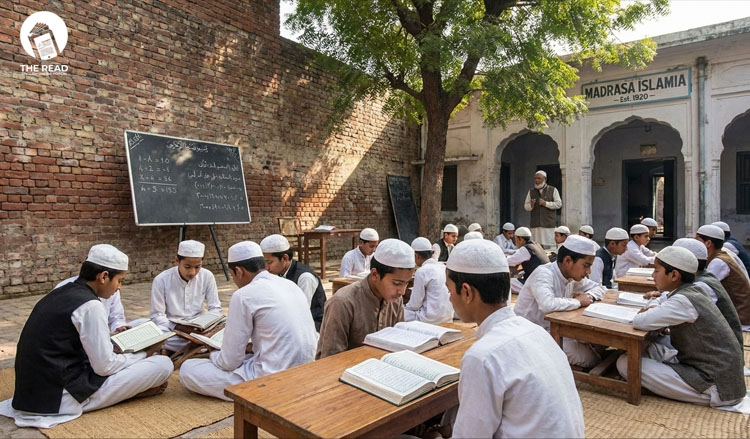
Madrasas in North India are recognized institutions that offer both religious and modern education, playing an important role in minority education. Recent demands to shut them down are based on prejudice rather than their actual functioning. The real challenges lie in poor leadership, mismanagement, and lack of reform. Instead of closure, these institutions need modernization and stronger oversight. Revitalizing madrasas is essential for educational justice and social resilience.
Knowledge and wisdom are the driving forces behind the progressive movement of society. Institutions like schools and Mosques play a key role in facilitating its effective transmission. Madrasas are one of these broader educational institutions that play a central role in this process. Madrasas serve as places through which the Muslim community develops and advances its knowledge production.
Its meaning and concept are far more expansive than just primary educational institutions. Barbara D. Metcalfe, a renowned historian who has done extensive research on Muslim religious educational institutions and madrasas in India, writes about the various usages of the term "madrasa": “The term ‘madrasa’ is used in India for a wide range of institutions. It may refer to mosques that taught the primary education to neighborhood students, institutions that provided primary government education along with religious education, educational institutions that provided higher religious studies along with non-religious subjects, or higher educational institutions that served as great repositories of the Islamic history of India. Until recent decades, India had madrasas renowned for higher education. Learners from various parts of the world, such as Central Asia, Afghanistan, Malaysia, and South Africa, came to India in pursuit of advanced learning in these institutions.
Recently, the National Commission for Protection of Child Rights (NCPCR) issued an update to state governments and Union Territories to discontinue funding programs to madrasas and to shut them down. This verdict led to widespread protests and criticism. Beyond the natural reactions of describing the verdict as methodologically unpleasant and misleading, it becomes crystal clear that the report is framed through prejudice and hatred.
The main suggestion of the report was to shut down the Madrasa Boards and withdraw all funds. The fact that the Child Rights Commission has taken up the continuous allegations that have been propagated by communal forces for ages, such as that madrasas are centers of torture and institutions that promote religious domination, is a big farce. This becomes clear from the title of the report itself. The report has been given a very romantic title, “Madrasas: Protectors of Faith or Violators of Rights?” The truth behind the report is evident from this inappropriate title.
The myths and misconceptions that exist in society about madrasas are largely rooted in the negative portrayal of Islamic institutions. This view is just purely inhumane. If it is in terms of the right to education, there are many more serious systematic violations still existing in this country that need urgent attention. Even today, a large population in this great country is still denied the basic right to education due to the lack of basic facilities or socio-economic conditions. This reality becomes immediately evident through a brief visit to several northern Indian states such as Uttar Pradesh, Bihar, and Assam. It was only after the Sachar Committee report that the rights of minority education as well as the Muslim community itself began to receive even a minimal level of recognition.
There is a significant difference between Madrasas in Kerala and those in North India. In Kerala, Madrasas are the institutions for providing primary religious education. There are also many educational institutions like academies, Sharia colleges, and universities for higher studies and religious degrees. On the contrary, in North India, primary religious education centers are called Maktabs. Madrasas are typically called centers for advanced Islamic studies, while those that provide advanced degree studies are called Jami’as. It is important to recognize this terminological difference for any serious analysis. There are two broad types of Madrasas in North Indian states. One is the government-run Madrasas. The other is the self-financed Madrasas. They may be either registered or unregistered. Madrasa boards were formed in the 1960s with the objective of bringing Muslim students into the mainstream.
The majority of madrasas in North India are educational institutions that provide secular education along with the existing religious studies syllabus. Students who have completed their studies in this institution will be eligible to obtain an educational certificate equivalent to the secondary (10th class) and higher secondary (Plus Two). In other words, madrasas operate as educational places with equivalent qualifications to government schools. Within this educational curriculum, the qualification equivalent to eighth class is Wustwaniya, Fawqaniya for the tenth class, Maulavi for Plus Two, Aalim for the degree level, and Falil for those pursuing postgraduate studies. Along with religious studies, material disciplines such as science and mathematics are also the main subjects of the madrasa curriculum. Yoginder Sikand's book Bastions of Believers: Madrasas and Islamic Education in India and Barbara D. Metcalf's study Madrasas and Minorities in Secular India, included in Schooling Islam, edited by Robert Hefner and Qasim Zaman, are also useful scholarly references for those who want a deeper understanding of madrasas and their historical development in India.
Similar to other government schools, madrasas also have the framework of aided and unaided systems. In most North Indian madrasas, the government provides teachers’ salaries, while responsibilities such as administrative management, operational expenses, infrastructure development, and teacher appointments are handled by the respective management bodies. The infrastructure development of these madrasas often utilized the funds of MP and MLA development schemes. Another section of madrasas is registered with the government but operates without any government assistance. These also operate with formal government approval.
These madrasas are not only recognized by the government but also receive the support of institutions like the Right to Education (RTE) and literacy missions. The conspicuous absence of visionary leadership to implement such public schemes is a problem in North India. The lack of socially committed people who selflessly intervene and take an active part in such educational initiatives has resulted in the madrasas in North India being in such a state of neglect. No paths ahead are closed to us yet. If there is a clear vision, coherent perspective, and foresight, and if efforts are made to restore it to its former glory, success remains at a one-hand distance. In the notification of inviting applications for the Agnipath recruitment scheme, it can be seen that madrasa certificates have been specifically mentioned. The lack of effective leadership and the inattentiveness and negligence of the existing ones are what relegate the Muslim community everywhere.
When we closely observe the educational activities in North Indian states, we find that the local management committees, which have the responsibilities of madrasas like teacher recruitment and infrastructure development, have become centers of corruption and loot. Numerous places today have madrasa committees that do not appoint qualified teachers or ensure proper maintenance. Instead of completely shutting them down, plans should have been formulated to utilize these educational centers more usefully. What is urgently needed is a more pragmatic approach to realizing the right to education.
The introduction of the National Register of Citizens (NRC) is the main reason for people in North India who have no awareness of the socio-political environment to realize the necessity of possessing official documents. This moment is an opportunity for us. A multi-dimensional renewal is highly essential in madrasas and similar educational institutions. The minimum standard of our madrasa system should be uplifted to the secondary level (12th standard). It is necessary to resist reports with communal agendas intellectually and politically. At the same time, it is equally important to make vigorous efforts to strengthen our socio-educational foundation. Only through becoming vigilant in the educational and social spheres can one prevent the erosion caused by a lack of awareness within the Muslim social base.




Comments