
Travel Tips
Lorem ipsum dolor sit amet, consectetur adipiscing elit.

Search
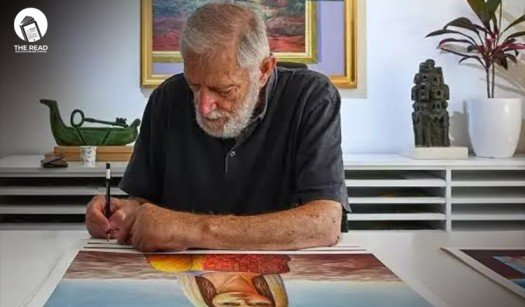
Through his paintings, Sliman Mansour transformed Palestinian identity, memory, and suffering into powerful visual expressions of resistance. From portraits of ordinary Palestinians to symbols such as the watermelon, his art reflected a people determined to preserve their history and cultural identity. This feature explores Mansour’s life, artistic journey, and enduring belief that art should serve society rather than merely decorate walls.
“I can easily go and work in my studio and forget about anything else and make flowers and nice girls and make exhibitions and sell and so on. But that's not how I am built. And artists should not do that. They should be more active in their society. I believe in art as a social instrument, not as decoration for wealthy people's houses.”
These are the famous words of the renowned Palestinian artist Sliman Mansour, spoken in an interview with Nick Hilden in response to his question, “So what is the artist to do in times of conflict or war?”
Sliman Mansour was a Palestinian artist who spent the lion’s share of his life painting portraits that represented the endurance of his community in the face of Israeli atrocities, as well as their resistance and survival.
Mansour was born in 1947 in Birzeit, near Ramallah, just a year before the Nakba, which resulted in the displacement of approximately 750,000 Palestinians from their homes. He grew up during a period when the Israeli authorities forbade the display of Palestinian national symbols, including the Palestinian flag. After completing his primary and secondary education in Ramallah, he pursued higher education and graduated in art from the Bezalel Academy of Jerusalem. Following the completion of his studies, he began participating in solo and group exhibitions and gained national and international recognition for his artistic work. His works are held in museums and private collections around the world, and he received numerous awards for his contributions to the Arab world, particularly to Palestine.
Over the course of his career, he painted numerous portraits that highlighted his community’s resilience, tolerance, and innocence. He was imprisoned for his activities and was severely punished during the period of Israeli occupation and invasion.
“Jamal al-Mahamil” is considered his magnum opus. In the painting, he portrays a bowed old man carrying the entire Jerusalem landscape, particularly the Dome of the Rock (Qubbat as-Sakhra’), within an eye-shaped curve. The image symbolizes the resistance, patience, and survival of the Palestinian people.
Moreover, his canvases mostly depicted village life, women wearing traditional thobes, and Palestinian embroidery. When Israeli officials forbade the use of the colours red, white, green, and black, the colours of the Palestinian national flag, Mansour, along with some of the prominent artists of his time, discussed ways to overcome this seemingly insurmountable hurdle. Eventually, they decided to paint watermelons and use them as a symbol of Palestinian identity and society.
After the First Intifada, Sliman Mansour, along with other Palestinian artists such as Vera Tamari, Tayseer Barakat, and Nabil Anani, founded the “New Visions” group. They boycotted Israeli-made canvases and other painting materials and began creating artworks using soil, mud, and other natural resources. Mansour preferred mud because of his childhood memories of his grandmother, who made beehives and ovens out of mud, with Mansour helping her. He recalled:
“So, when I thought about material that I could use, mud was the first thing that came to my mind. After a while, once I started making figures, I realized that the mud also reflects human fate with the cracks, people waiting to disappear, and falling and going away.”
Despite this, Mansour also laid the foundations for various artistic institutions to promote Palestinian art and support Palestinian artists. These included the establishment of the al-Wasithi Arts Center, which sought to protect Palestinian art and artists living in areas occupied by Israel. He was also regarded as one of the founding members of the International Academy of Art Palestine in Ramallah. Mansour’s paintings can be found in museums and collections around the world. Notable institutions that hold his works include the Guggenheim Abu Dhabi, Mathaf: Arab Museum of Modern Art in Doha, and Dar El-Nimer for Arts and Culture.
Rather than relying solely on painting, Mansour also became known as an author and a noted cartoonist. He believed that even a single act of resistance against an institution seeking to erase Palestinian identity constitutes a political statement.
This artistic polymath was admitted to al-Maqasid Hospital in Ramallah following a stroke and passed away on 24 August 2026, at the age of 79.




Comments