
Travel Tips
Lorem ipsum dolor sit amet, consectetur adipiscing elit.
Search
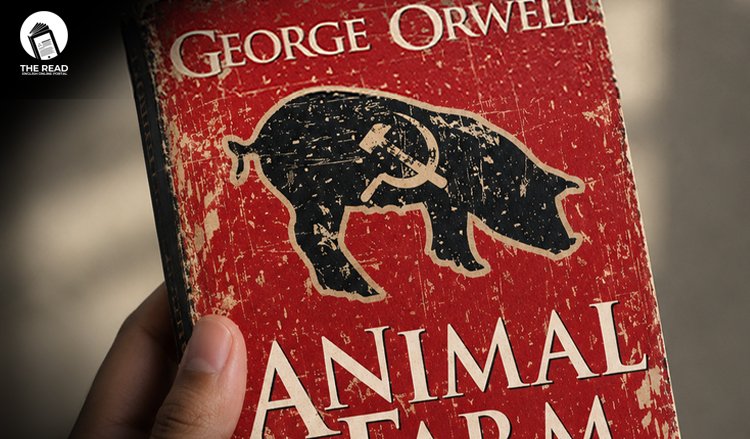
At first, I thought Animal Farm by George Orwell was simply a story about animals rebelling against their master. It felt so realistic that I was shocked. But as I moved deeper into the novel, I realised that this masterpiece does not merely exist within the book; it reflects our own society. It shows how quickly truth itself can become something that is easily manipulated and how what we once understood as rebellion can eventually become tyranny. In today's world, as we have witnessed, news can be framed to serve particular agendas; misinformation can shape public opinion; social media can rapidly spread misleading headlines and selective reporting, and society can gradually become unable to question what it is told.
Just imagine our own day-to-day life. Every morning when we wake up, news and information are already in front of us through notifications on our mobile phones, and we do not even have the opportunity to search for or verify them ourselves. So, nowadays, we live in an age where truth sometimes feels scarce, while information is abundant.
I found some aspects of the novel particularly relevant, especially in this age of algorithms. Today, emotionally charged stories often gain more attention than complicated issues. Our algorithms and personalised feeds can expose us to information that agrees with our existing beliefs; soon, we may begin to mistake repeated exposure for reality. At the same time, the past can easily be altered in our memory and in the information we encounter; old promises can disappear from public attention and gradually become difficult to prove.
So, several questions arise. Did we really read anything beyond the headlines? Did we check the source? Are we willing to believe something that challenges our existing beliefs? We have more information than any previous generation, yet truth can still feel fragile. Can I simply believe everything I see? Is there evidence to support what I have accepted as real? Am I accepting something because it is true or because I want it to be true? And perhaps the most important question raised by Animal Farm is this: Why do revolutions begin by promising freedom and equality, only to sometimes turn into the very oppression they sought to abolish? How does a movement created to liberate people gradually transform into a system in which people suffer for the freedom they once fought to achieve?
In Animal Farm, a pig character named “Squealer” plays a pivotal role in transforming the beliefs of the entire farm. In the novel, Squealer does not force the animals to accept information through physical strength; instead, he confuses them with statistics, distorted explanations, and persuasive arguments, presenting Napoleon's decisions as necessary for their welfare. As a result, the animals gradually begin to distrust their own lived experiences. Squealer, therefore, has the power to influence how the other animals understand reality. 
His behavior and role remind me of contemporary news channels and social media, where information can sometimes arrive in the form of half-truths, selective reporting, and misleading headlines. It is not unusual to see two news reports in Kerala describe the same incident in different ways. Even though the event itself remains the same, the narrative surrounding it can change depending on how it is presented, as can be seen in controversies surrounding public remarks, including the issue related to prominent Islamic scholar Kanthapuram's remarks on women.
It is easy to read such a classical work as Animal Farm and conclude the entire discussion simply by saying that propaganda is something created by organisations and governments. But its significance becomes clearer when we reconsider and rethink the warning George Orwell tried to convey to the real world. Manipulation through information does not become powerful simply because of who produces it; it becomes powerful when people accept it without asking questions or seeking evidence. Gradually, this phenomenon can create a culture in which people begin to believe lies and distrust the truth because they become increasingly detached from reality. The responsibility does not belong only to journalists, governments, or technology companies; it also belongs to everyone who reads, accepts, and shares information. So, the important lesson I took from the novel is this: a society does not lose its relationship with truth in one dramatic moment; it happens gradually, until truth itself becomes increasingly difficult to identify.
Why do revolutions that begin with promises of freedom and liberty sometimes end by reproducing the very oppression they sought to abolish? Orwell conveys this idea through the way the animals gradually move from rebellion to obedience after overthrowing Jones and his oppressive rule. Soon, a pig named “Napoleon” becomes the supreme leader, using his dogs as instruments of intimidation and coercion. In the allegorical context of the novel, the dogs can be understood as representing the coercive power of the Soviet secret police and the political repression associated with Stalinist rule. Eventually, Napoleon separates himself from the other animals, just as Jones had done before him. Here, we can identify an important political principle: a revolution may overthrow a ruler, but it does not necessarily dismantle the structures that allow power to become concentrated. The Seven Commandments also gradually become flexible. Although they were originally intended to apply equally to everyone, they are altered over time to suit the interests of the new leadership. A new constitution or set of principles may be written, but the existence of rules alone does not guarantee that power will remain restrained. The political developments in Egypt following the 2011 revolution and the removal of Mohamed Morsi in 2013 also raise questions about whether changing political leadership necessarily transforms deeper structures of power.
In this masterpiece, George Orwell uses each character and event as an allegorical representation of political and social realities. At the beginning, the animals' suffering under Jones represents the injustice and tyranny that people may seek to overcome. Jones's overthrow represents a revolution undertaken to end oppressive rule. The Seven Commandments represent constitutions, laws, and principles of equality and freedom established after a revolution. Napoleon represents the concentration of political power and the rise of authoritarian leadership. Squealer represents propaganda and the use of information to justify the actions of those in power, much like the way some media organisations can shape public narratives. Napoleon's dogs, who suppress opposition through force, represent the coercive apparatus used to silence resistance. Boxer the horse represents the hardworking and exploited people whose loyalty and labour can be used by those in power. Finally, the pigs' eventual relationship with the humans represents the restoration of the very inequality and hierarchy that the revolution originally sought to destroy.
Through these characters and events, Orwell connects the fictional world of the farm with real political and social realities. Almost every part of the novel reminds me of aspects of human history and contemporary society. I particularly appreciate the way Orwell conveys such serious ideas through the simple and accessible form of an animal story. The novel creates a powerful atmosphere while leaving meaningful questions for every reader about power, truth, equality, and human nature.




Comments